
For a long time, I used to wonder why organizations sometimes let go of people who seem absolutely critical to the team and then hire someone completely new instead.
On the surface, it feels risky. Existing employees understand the systems, the culture, the stakeholders, and the history. Replacing that level of institutional knowledge doesn’t seem logical.
But over time, I realized something important: these decisions are rarely about competence alone.
More often, they’re about alignment, adaptability, and the future direction of the organization.
When Capability Isn’t the Problem Growth Is
Even highly capable employees can reach a point where growth slows down.
They may still perform well, but:
- They become comfortable with existing ways of working
- They resist new ideas or technologies
- They stop questioning “how things have always been done”
At that stage, contribution continues but progress doesn’t. In contrast, new hires often arrive with:
- Fresh energy and curiosity
- Different experiences and perspectives
- A willingness to learn, adapt, and prove themselves
That mindset can be incredibly valuable especially when an organization is evolving, transforming, or responding to market change.
Of course, hiring new people isn’t a guaranteed win. Some struggle to adapt. Some never fully align with the culture. And sometimes, the “fresh perspective” doesn’t materialize. That’s why the real question isn’t new vs old it’s future fit vs familiarity.
The Psychological Contract: The Unspoken Agreement
This dynamic closely aligns with Psychological Contract Theory, introduced by Denise Rousseau.
The psychological contract represents the unwritten expectations that exist between employees and their organizations.
Employees typically expect:
- Opportunities for growth and development
- Recognition and fair treatment
- Meaningful work and a sense of purpose
Organizations, in turn, expect:
- Commitment and accountability
- Adaptability to change
- Continuous and evolving contribution
Problems arise when this balance begins to break. An employee may feel undervalued or stuck, while the organization may perceive that the employee is no longer evolving. As these expectations quietly drift apart, disengagement sets in often leading to eventual separation.
A Cultural Shift in Practice: Microsoft
A real-world example can be seen at Microsoft under the leadership of Satya Nadella.
Nadella led a cultural transformation from internal competition and a “know-it-all” mindset to collaboration and a “learn-it-all” culture.
This shift required people to think and work differently. Some long-time employees who thrived under the old system struggled to adapt and eventually moved on. Microsoft chose cultural and strategic alignment over familiarity even when it meant losing experienced talent.
The decision wasn’t about replacing people. It was about building the organization needed for the future.
Growth Mindset and Organizational Survival
This ties directly to Growth Mindset Theory, introduced by Carol Dweck.
- A growth mindset embraces learning, challenge, and change
- A fixed mindset prefers stability and resists discomfort
In fast-changing industries, growth mindset isn’t optional it’s essential.
IBM’s Strategic Transition
When IBM shifted from hardware-centric offerings to cloud computing and AI services, it invested heavily in reskilling its workforce. Many employees successfully transitioned. Others couldn’t or didn’t want to. Those roles were gradually replaced with talent aligned to IBM’s future capabilities. This wasn’t about tenure it was about relevance.
Functional vs. Dysfunctional Turnover
Not all employee turnover is bad.
Functional turnover occurs when low performers or employees who are misaligned with the organization’s direction leave often benefiting the organization.
Dysfunctional turnover happens when strong, future-fit performers exit, potentially causing harm.
However, the distinction isn’t always obvious. A high-performing employee whose skills or mindset no longer align with future business needs can become a strategic risk, not an asset. This is why forward-looking organizations evaluate retention through a future-focused lens, rather than relying solely on past performance.
Key questions organizations increasingly ask include:
- How much critical knowledge would actually be lost?
- Does retaining this role encourage growth or stagnation?
- What skills and capabilities will the organization need next?
- How is the company culture evolving?
Sometimes, short-term disruption creates long-term resilience.
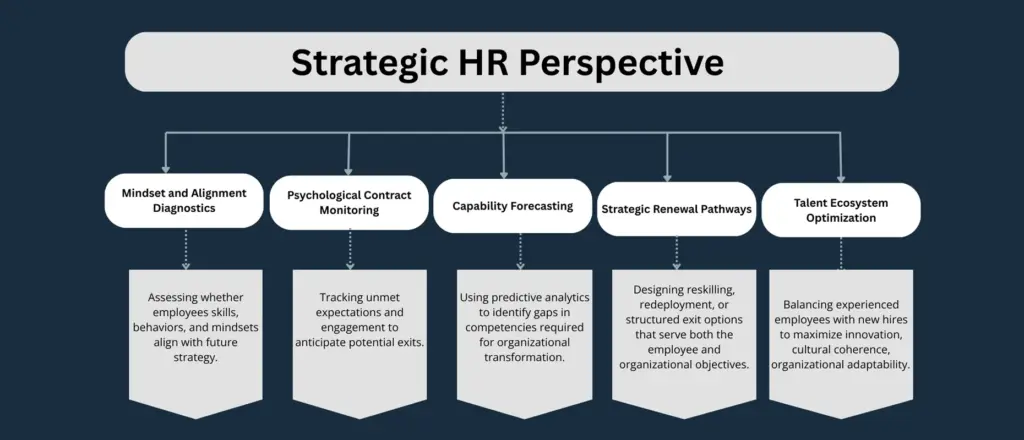
Strategic HR Perspective
From a strategic standpoint, HR functions as a cognitive, predictive system. Employee exits are not automatically viewed as losses. Instead, they are treated as signals within an adaptive talent ecosystem, indicators of alignment, capability gaps, or cultural friction. This perspective allows organizations to act intentionally rather than reactively.
What This Means for HR and Leadership
Modern HR isn’t just about retention it’s about intentional retention.
Effective organizations:
- Continuously assess skill and mindset alignment
- Prioritize reskilling before replacing talent
- Treat exit interviews as learning mechanisms
- Balance stability with renewal
- Focus on future readiness, not just tenure
From this lens, employee exits become strategic data points, not failures.
The central question shifts from:
“Why did we lose this employee?”
to:
“Does our talent ecosystem align with where we’re going?”
Conclusion: Exit as Evolution
Even the departure of key employees isn’t always a loss. When handled thoughtfully, exits can:
- Create space for innovation
- Refresh energy and culture
- Expose leadership or process gaps
- Enable long-term organizational growth
Organizations evolve. Markets change. Technology advances. And sometimes, people and organizations simply grow in different directions. That doesn’t erase past value it means the fit has changed.
Ultimately, employee exit isn’t about attrition. It’s about adaptation.
And when approached strategically, it becomes a natural and healthy part of building a resilient, future-ready organization.
 Anwesha Bose
  Mitul Khurana
  Deepa Kalra