

People are our greatest asset.
It is one of the most widely repeated statements in business.
Yet in many organizations, the systems responsible for enabling people to create value are still designed primarily for operational efficiency rather than strategic capability.
Across functions—finance, operations, customer service, and HR—leaders spend a significant portion of their time managing processes: coordinating activities, resolving operational issues, ensuring compliance, and maintaining organizational stability.
This work is essential. Organizations cannot function without it.
But processes alone rarely create competitive advantage.
Competitive advantage emerges when organizations design systems that align people, capabilities, and decisions with strategy.
And this is where a new shift may be emerging.
AI as a Companion to Organizational Capability
Much of the current conversation around AI focuses on automation.
AI answering customer queries.
AI analyzing operational patterns.
AI supporting reporting and analytics.
AI assisting with workforce insights.
These capabilities will undoubtedly make many processes faster, more accurate, and more efficient.
Research increasingly suggests that AI’s greatest impact will come from reducing routine operational work.
According to McKinsey, generative AI could automate up to 60–70% of routine knowledge-work activities, particularly tasks involving information processing, documentation, and analysis.
Similarly, Deloitte’s State of AI in the Enterprise research shows that most organizations expect AI to augment human decision-making rather than replace it.
This suggests that the deeper transformation may not lie in automation alone.
Instead, it lies in what becomes possible when operational complexity begins to fade.
Organizations are fundamentally human systems, built on trust, collaboration, judgment, and culture. These elements cannot be replaced by algorithms.
What AI can do, however, is reduce the operational load that consumes a large portion of managerial attention today.
When that happens, leaders gain something incredibly valuable —
strategic bandwidth: the ability to step back from operational complexity and focus on how the organization itself should evolve.
But what exactly should leaders focus on once that space opens up?
One way to understand this is to look at how work typically operates inside organizations. Most activities tend to fall across three distinct layers of influence — each shaping the organization in different ways.
The Three Layers of Organizational Influence
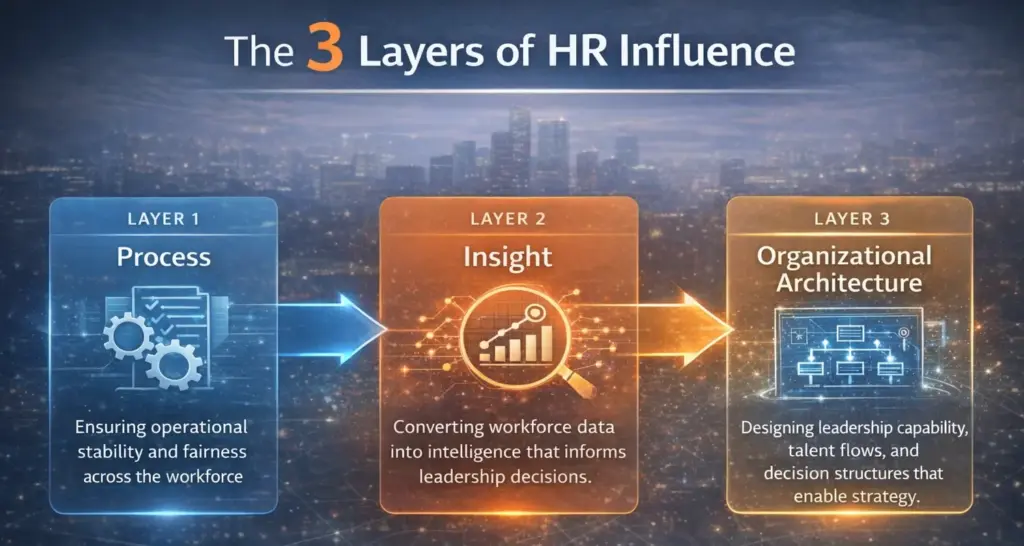
Layer 1: Process — Ensuring Organizational Stability
Every organization depends on strong operational processes.
- Recruitment cycles
- Financial reporting
- Customer service operations
- Compliance systems
- Performance management frameworks
These processes create consistency, accountability, and stability across the organization.
Without them, organizations quickly become fragmented and difficult to manage.
However, this layer largely focuses on maintaining the system rather than shaping it.
For many leaders today, this layer still dominates daily work.
Here AI increasingly acts as an operational companion, automating routine coordination, employee queries, documentation, and reporting tasks.
By handling much of this administrative complexity, AI allows organizations to maintain operational stability with significantly less managerial effort.
Layer 2: Insight — Generating Organizational Intelligence
The second layer is where organizations begin to convert information into insight.
Modern organizations generate enormous volumes of data:
- Customer behavior patterns
- Operational performance metrics
- Financial indicators
- Workforce engagement and capability data
AI has the potential to significantly enhance how this information is interpreted.
By identifying patterns across large datasets, AI can reveal signals that would otherwise remain hidden — signals about capability gaps, emerging risks, structural inefficiencies, and opportunities for improvement.
Companies such as Unilever and IBM already illustrate how AI can strengthen workforce decision-making.
Unilever has integrated AI into its talent processes to improve recruitment decisions and analyze workforce capabilities, helping identify skill gaps and guide internal mobility.
Similarly, IBM has long used AI-driven workforce analytics through its Watson HR platform to predict attrition risk, forecast skills demand, and support more informed talent planning.
At this stage AI acts as an analytical companion, helping transform data into organizational intelligence.
When leaders interpret these signals effectively, organizations move from reactive management to informed decision-making.
At this stage AI acts as an analytical companion, helping transform data into organizational intelligence.
Layer 3: Organizational Architecture — Designing the System
The third layer represents the most strategic dimension of leadership.
Here the focus shifts from running processes or analyzing data to designing the systems through which value is created.
Questions at this level include:
- What capabilities will the organization need for its next phase of growth?
- Where are structural bottlenecks limiting performance?
- How should decision-making authority flow across the organization?
- How should talent and knowledge move across teams to accelerate learning and innovation?
At this level leaders are not simply managing work.
They are designing the organization itself.
AI does not replace decisions at this level. Instead, it acts as an intelligence partner, helping leaders explore scenarios and test assumptions while humans ultimately design the organizational system.
How This Organizational Shift Plays Out in HR

While these three layers apply across most functions, the shift becomes particularly visible in areas where operational complexity has historically dominated the agenda.
Few functions illustrate this transition more clearly than HR.
For decades HR has been encouraged to become a strategic partner to the business.
- Frameworks were introduced.
- Roles were redesigned.
- The language of strategic HR became widely adopted.
Yet the operational reality for many HR teams remains similar.
Large portions of time are spent managing:
- Recruitment coordination
- Policy interpretation
- Performance management cycles
- Employee relations issues
- Compliance and reporting
These responsibilities are critical. They ensure fairness, consistency, and stability across the workforce.
But they also create operational gravity that limits the time available for deeper strategic work.
As AI reduces administrative complexity—from employee queries to workforce analytics and reporting—HR gains the opportunity to redirect its focus.
From managing people processes.
To shaping how the organization enables people to contribute and grow.
At that point HR’s role begins to evolve.
Not merely as managers of people processes.
But as architects of organizational capability — helping design how leadership, talent, and culture align with strategy.
AI Generates Insight. Humans Architect Organizations.
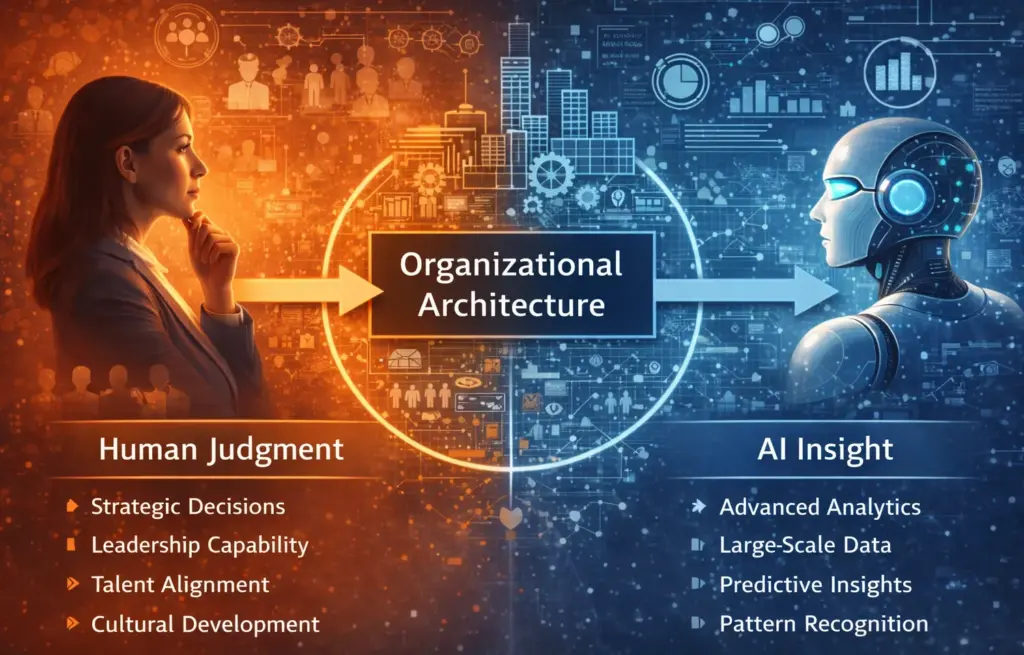
Technology alone does not transform organizations.
AI can surface insights and reduce operational friction.
But decisions about leadership, culture, capability development, and organizational design require context, judgment, and human understanding.
Technology expands analytical capability.
Human judgment determines how organizations evolve
The Real Opportunity
Perhaps the most important impact of AI across organizations will not be automation.
It will be the strategic bandwidth that allows leaders to focus on the deeper questions that shape long-term success:
Leadership capability
Talent systems
Organizational design
Decision architecture
Cultural alignment with strategy
These are the domains where organizations build enduring advantage.
THE QUESTION THAT NOW MATTERS
The question is no longer whether AI will replace people.
The real question is how organizations will use the intelligence and space that AI creates.
Technology alone will not determine which organizations succeed.
The advantage will belong to those that use this moment to strengthen leadership, build deeper capabilities, and intentionally design how their organizations evolve.
Because when operational complexity begins to fade into the background, leadership attention shifts to something far more important:
Architecting how organizations create value through people.
Not merely managing processes.
But designing the systems through which people, capability, and decisions come together to drive performance.
In that future, the role of leadership — and functions like HR — is not simply to run the organization.
It is to architect it
 Anwesha Bose
  Apeksha Malviya
  Deepa Kalra